Falling Behind on Reporting
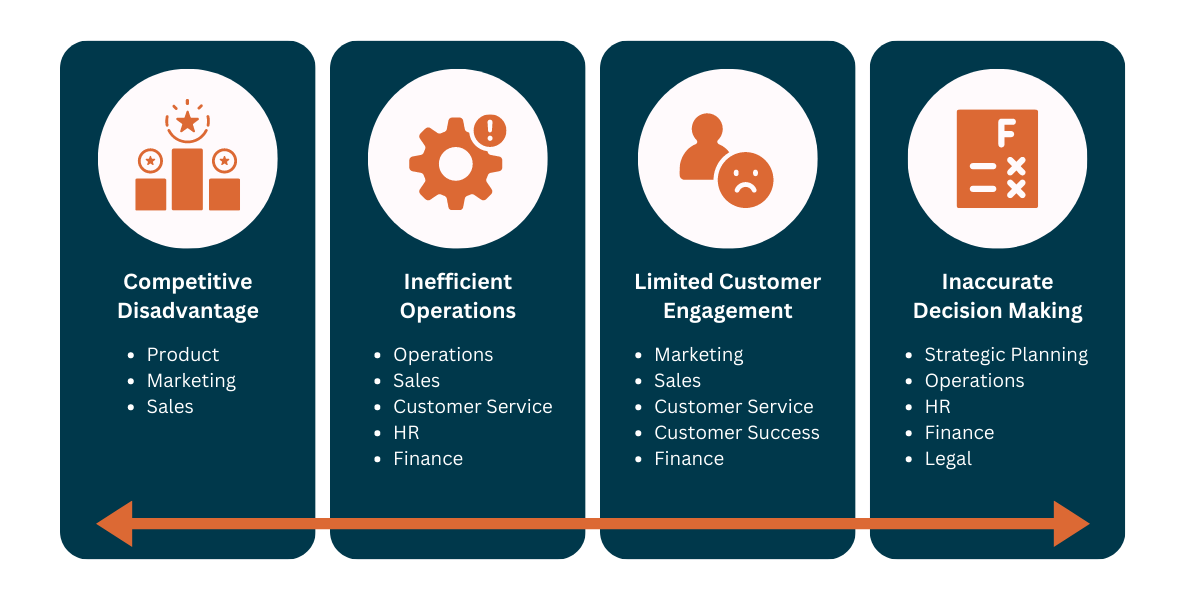
For example, most companies today provide online reporting to their customers. The report is not the product, the report simply provides insight into how the customer consumes and values the product. Yet reporting is seen by many consumers, especially in the B2B space, as a key differentiator.LLMs can provide customers with a superior reporting experience by providing a flexible Q&A approach and deeper personalized insights, to name a few.
Limiting Marketing Personalization
The effectiveness of marketing personalization is often limited by the amount of content the marketing team can create. This is why personas that distill a customer into one of a few “types” is so popular today. LLMs don’t need personas — they can incorporate all of the information about a customer and create marketing content on a true 1:1 scale. LLMs are pushing the cost of content creation to zero while still outperforming those businesses that rely on basic demographics or recent transactions.
LLM Opportunity: Where to Get Started?
When a single tool crosses so many functional departments of a business, it can be hard to get started. Furthermore, how does a whole business or functional unit evaluate LLM opportunities if they lack an understanding of what’s possible? Leadership needs a team member who can educate the business on specific opportunities and be accountable to the functional leader for the success of the LLM project.
LLM Education and Low Risk Trial
Today’s LLM-buying conversation often starts with a demo or use case. Conversation can quickly shift to buying, using, and growing LLMs. Unfortunately, the focus on adoption doesn’t meet many businesses where they are today. Without an understanding of safeguards and risks, providing new technology access to sensitive data or licenses to engage with customers is simply too risky for business. Today, businesses need LLM education and a low-risk way to try LLMs. Once educated and validated, your business is in a position to discuss adoption.
How does business leadership get educated on LLM opportunities? One way is to create an LLM innovation goal within the organization. The sole objective of the LLM innovation goal is to identify and educate leadership about high-value LLM opportunities. Identifying the LLM innovation goal should be completed quickly, and the output is documentation and discussion with leadership about the identified opportunities to evaluate where, and if, a low-risk LLM trial is warranted.
Bring LLM Opportunity to Your Organization
LLMs are extremely powerful but need a leader to help wrangle the opportunity and educate the team. Even for this article, asking an LLM about the risk of not exploring LLMs required some human intervention. To be clear, it’s not that a human must review every LLM decision or that the output cannot be trusted. Nor is it that LLMs are too risky for business.
In fact, it’s quite the opposite: If an organization doesn’t assess the opportunity for LLMs to organize information, automate, and provide insight, the business is potentially at risk. Once an opportunity is understood and guardrails are in place, LLMs can be an important tool in an automated workflow.
In the gap between “we should explore LLMs” and “let’s add this LLM to our process tomorrow” is the need for a leader to help educate and guide a business towards its LLM goals. And Stellar is here to help implement and build solutions to achieve them.